



Why Most Traders Lose During News Events — And It’s Not Because of Volatility
Author: Ratender Singh Dhull
Every trader remembers their first major news event. The market suddenly begins to move faster than usual. Candles expand, spreads widen, and everything feels intense and full of opportunity. It looks like easy money. The market feels alive, almost electric.
So the trader enters a position with confidence and excitement.
Within minutes, the trade is stopped out, slipped heavily, or completely reversed.
The conclusion that follows is almost always the same:
“The market was too volatile.”
But that explanation, while comforting, is incomplete. Most traders don’t lose during news events because of volatility. They lose because they misunderstand what the market is actually doing during those moments.
News Events Don’t Create Movement — They Reprice Expectations
Many retail traders believe news events exist to create movement. In reality, news events exist to reprice expectations. Markets move not because of the news itself, but because the news either confirms or contradicts what participants were already expecting.
If inflation is expected at 3.2% and comes at 3.1%, markets may rally.
If it comes exactly at 3.2%, markets may barely react.
If it comes at 3.4%, markets may fall aggressively.
The key insight is simple:
Price reacts to the difference between expectation and reality — not the headline number.
Retail traders focus on headlines, while professional traders focus on expectations. That shift in perspective completely changes how news events are understood.
The Positioning Trap Most Traders Don’t See
Before any major news release, institutions are already positioned in the market. Banks, hedge funds, and asset managers do not wait for the news. They build positions days or weeks in advance based on forecasts and probabilities.
This creates market positioning — and positioning often matters more than the news itself.
Sometimes good news causes markets to fall because institutions have already bought heavily and are taking profits. Sometimes bad news causes markets to rally because expectations were worse and short positions begin to unwind.
Retail traders often feel confused in these situations, but the market is reacting to positioning and expectations rather than just headlines.
Volatility Is Only the Symptom
Volatility during news events is highly visible, but it is only a symptom — not the root cause of losses.
What actually drives price movement during these moments is the collision of three forces:
Repricing of expectations
Position unwinding
Liquidity gaps
When these forces interact, price moves rapidly. However, the speed of the move itself is not what causes losses.
The real problem is trading without context.
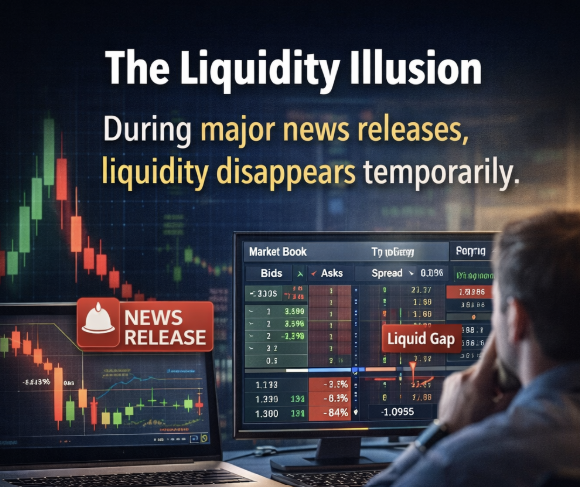
The Liquidity Illusion
During major news releases, liquidity often disappears temporarily. Large institutions pull orders, wait for clarity, and avoid being caught on the wrong side of sudden repricing.
This creates thin order books where even small orders can move price aggressively.
As a result:
Slippage increases
Spreads widen
Stop losses trigger instantly
Retail traders interpret this as strong momentum. In many cases, it is simply a lack of opposing orders.
It’s not manipulation.
It’s a temporary imbalance in liquidity.
Reaction vs Repricing: The Real Difference
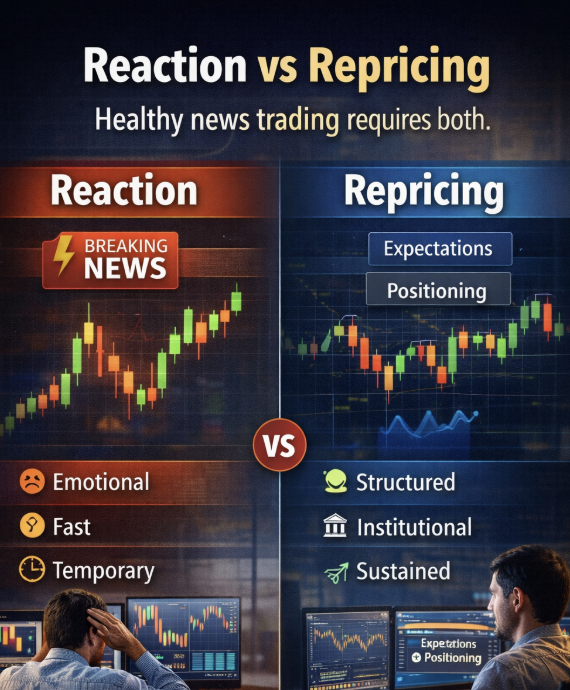
Most retail traders believe news events are about reaction.
But markets are actually about repricing.
Reaction phase:
Fast, emotional, temporary, driven by headlines and algorithms.
Repricing phase:
Slower, structured, driven by institutional positioning and real money flow.
Many traders enter during the reaction phase and exit before the repricing phase even begins. Others enter at the exact moment institutions are taking profits.
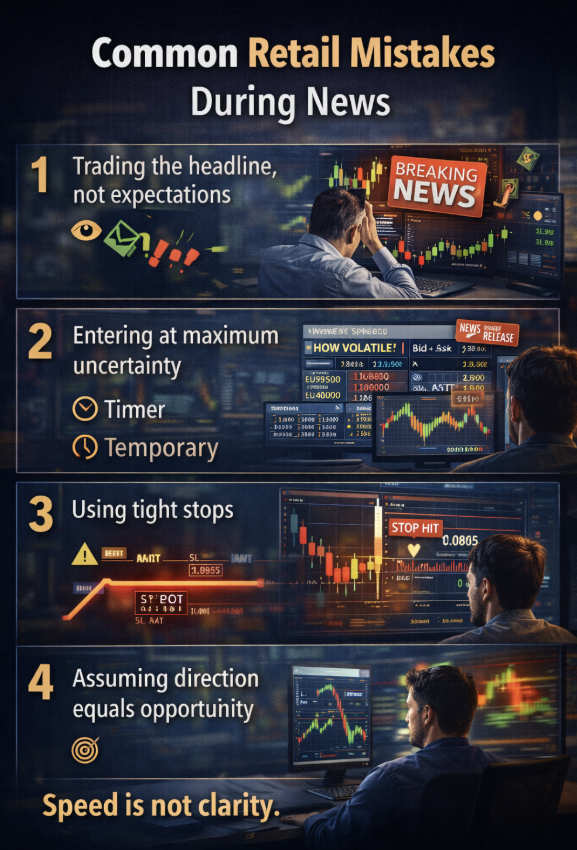
Common Retail Mistakes During News
Here are the most frequent errors traders make:
Trading the headline, not expectations
Entering immediately after seeing a “good” or “bad” number.Entering at maximum uncertainty
Right after release when spreads are widest.Using tight stops
Stops that work in normal markets fail during news.Confusing speed with opportunity
Fast movement doesn’t always mean tradable movement.
Speed is not clarity.
How Professionals Approach News Events
Professional traders rarely chase the first spike. Instead, they observe:
Pre-event narrative
What does the market expect?
How is it positioned?Post-event structure
Does price confirm the narrative?
Is there follow-through?Liquidity normalization
Are spreads tightening?
Is structure returning?
Only after these conditions appear do many professionals consider entering.
A Simple Rule for Traders
If you don’t know:
What the market expects
How it is positioned
What narrative is dominant
Then trading news is not a strategy.
It’s speculation.
Sometimes the best trade during a news event is no trade at all.
Final Insight
Volatility doesn’t cause losses.
Misunderstanding the market does.
When traders understand expectations, positioning, and liquidity, news events stop appearing chaotic and start appearing structured. They become moments of opportunity for those who have clarity.
In trading, clarity will always be more valuable than speed.